
Quantum Entanglement in the United States: A New Frontier in Science and Security
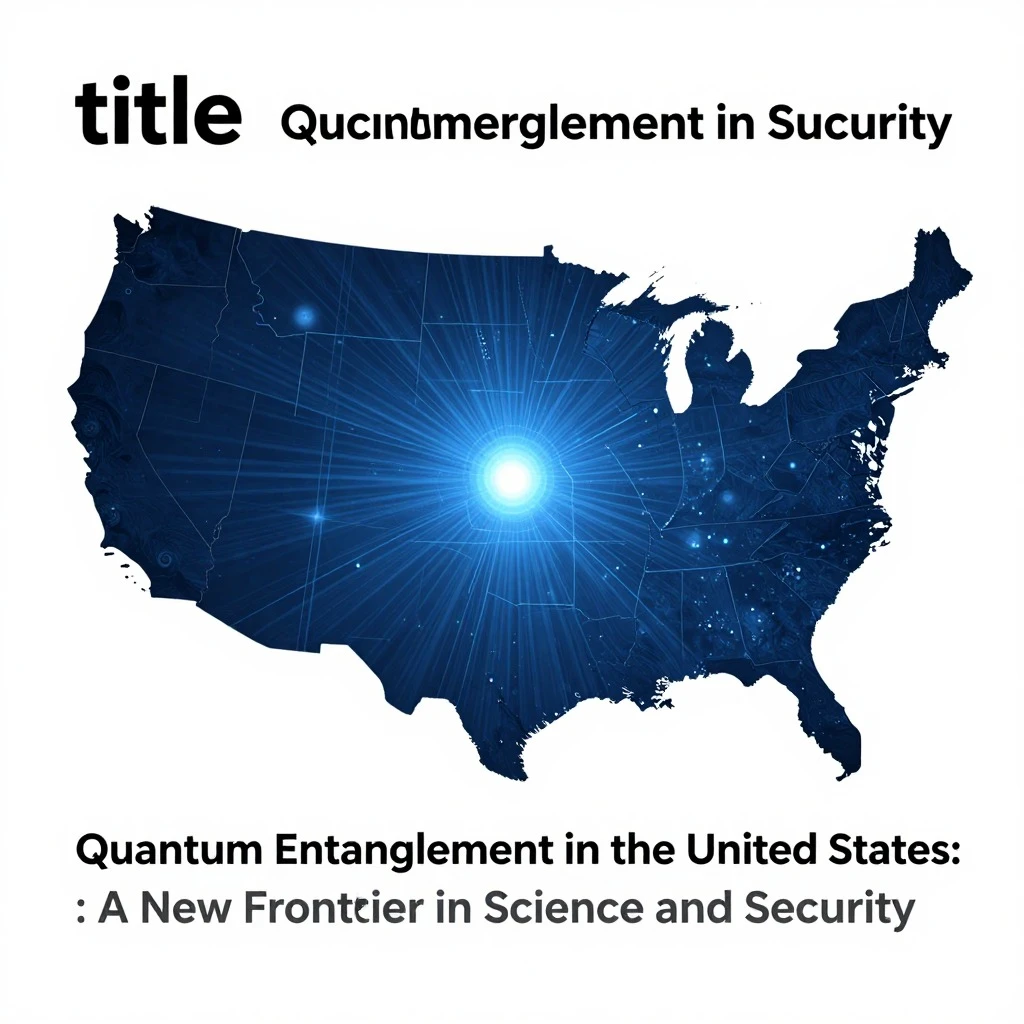
Quantum entanglement, a phenomenon where particles become inextricably linked regardless of distance, is at the heart of the disparity between classical and quantum physics. In the United States, this enigmatic feature has become a focal point of research and investment, promising to revolutionize fields from computing to secure communication. As John Preskill, the Richard P. Feynman Professor of Theoretical Physics at Caltech and director of the Institute for Quantum Information and Matter, states, “We are making investments in and betting on entanglement being one of the most important themes of 21st-century science.” This bet is already paying off, with breakthroughs that challenge our understanding of reality and open doors to unprecedented technologies.nnOne of the most significant applications of entanglement is in quantum key distribution (QKD), a method for secure communication. The E91 protocol, published by Artur Ekert in 1991, was a pioneering step in this field, leveraging entanglement to create unbreakable encryption keys. In the U.S., researchers and companies are actively developing QKD systems to protect against adversarial threats, including the potential of quantum computers to break current encryption standards. The race is on to deploy entanglement-based security before such threats become a reality. However, the question remains: Is any progress pivotal enough to compete with adversarial threats? This urgency drives continuous innovation and investment in quantum technologies across the nation.nnEntanglement also plays a crucial role in fundamental physics, particularly in tests of quantum mechanics versus classical intuitions. When two particles, such as photons or electrons, become entangled, their measurement outcomes are correlated in ways that cannot be explained by classical physics. For instance, in particle decay processes, conservation laws ensure that the properties of daughter particles are highly correlated. Even when measurements are made in moving relativistic reference frames, where each measurement occurs before the other in its own time frame, the correlations persist. This relativity remains intact, as entanglement does not involve faster-than-light communication, a common misconception. Instead, it reveals a deeper, non-local connection that Einstein famously called “spooky action at a distance.”nnIn the United States, institutions like Caltech, MIT, and Stanford, along with national labs and tech giants, are pushing the boundaries of entanglement research. A key to recent successes has been

 Shimanta Das