Supreme Court Allows Border Wall in Big Bend
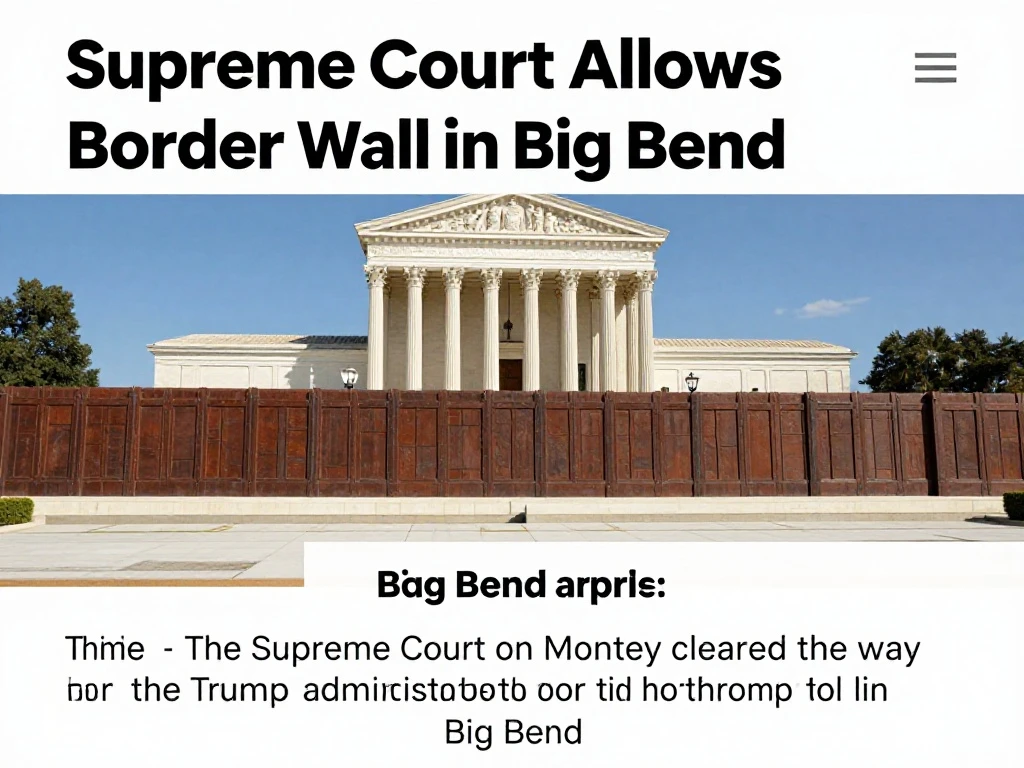
The Supreme Court on Monday cleared the way for the Trump administration to continue construction of a border wall through Big Bend National Park in Texas, a remote and ecologically sensitive area along the U.S.-Mexico border. The decision lifts a lower court injunction that had halted construction while legal challenges proceeded. The wall, a 30-foot barrier, has been a cornerstone of President Trump’s plan to tackle illegal immigration, and the administration argued that halting construction would impede its compelling interests in border security and integrity.
The case centered on the Illegal Immigration Reform and Immigrant Responsibility Act (IIRIRA), which the Supreme Court majority said shows “a clear preference for expeditious border construction” over the harms alleged by the plaintiffs. The plaintiffs, represented by lawyer Eric Glitzenstein, had argued that if the lower court’s order was paused or lifted, it would permit the administration to “immediately resume blasting, bulldozing, road construction, and other border barrier-related construction across one of the most remote and ecologically and culturally significant landscapes in the United States.” They also raised concerns about the wall’s environmental impact, noting that annual apprehensions in the Big Bend Sector have ranged between 0 and a tiny percentage of total border apprehensions, making the area a low priority for enforcement.
The lower court judge, Cardone, had relied on the major questions doctrine—the principle that if Congress intends to give a federal agency the power to make decisions of vast economic or political significance, it must say so very clearly. Cardone concluded that the government’s interpretation of IIRIRA would render limiting language meaningless. However, the Supreme Court majority disagreed, writing that the order “impedes the Government from advancing its ‘compelling interests’ in border security and integrity.” The government’s lawyer, John Sauer, argued that Cardone lacked the power to consider the challengers’ claim because their complaint specifically alleged that the DHS secretary lacked clear congressional authorization to issue the waivers under IIRIRA—a statutory claim that Congress denied district courts the authority to entertain.
The ruling allows construction to proceed while litigation continues, but the legal battle over the wall’s impact on Big Bend’s unique landscape is far from over. The


 Shimanta Das