
Army’s Iowa Lead Azide Blast: Safety vs. Risk
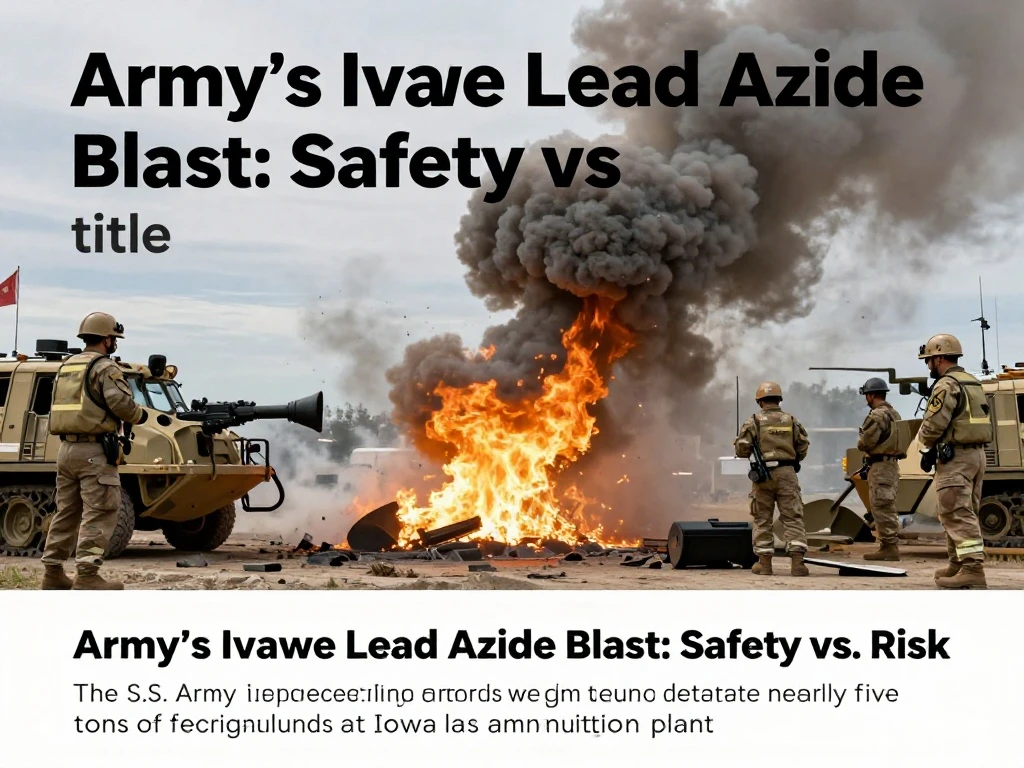
The U.S. Army is proceeding with a plan to detonate nearly five tons of a toxic lead-containing compound at the Iowa Army Ammunition Plant in Middletown, Iowa, despite a court order that initially halted the operation. The compound, lead azide, is a highly sensitive explosive used in detonators and other munitions. The Army argues that the material has degraded and become unstable, posing a risk of accidental detonation if left in storage. However, the decision has sparked concerns among local officials and environmental advocates about the potential for toxic fallout and the adequacy of safety measures.
On October 26, Charles Massner, the mayor of Mediapolis, Iowa, received an email from the Army notifying him of an “intentional, controlled detonation” of “a quantity of degraded lead azide” in the “near future” at the plant, located about 20 miles south of Mediapolis. The email, reviewed by WIRED, provided no details about when the explosion would occur, how much material would be destroyed, or what steps officials should take to protect the public from possible toxic fallout. This lack of information has left local leaders and residents in the dark about the risks they may face.
The Army’s environmental assessment acknowledges that the chemical neutralization process—an alternative to open detonation—requires significantly more “hands-on” time and physical manipulation of the drums by personnel over a prolonged 7- to 22-day period, drastically increasing the probability of accidental, fatal detonation during handling. Additionally, uncertainty remained for successful neutralization, including the existing mixture of water/ethanol the lead azide is contained in. These factors led the Army to conclude that open detonation is the safer option for disposal.
According to the assessment, the potentially hazardous zones for lead air dispersion have shrunk significantly compared to previous estimates. However, the concentration of lead in the air will depend on how the detonation occurs and, significantly, how the weather behaves. “The primary concern that we have right now is that lead azide can become more volatile when it is exposed to lower temperatures, and as the weather in Iowa gets colder, we’re very concerned that there could be uncontrolled detonation,” said one expert, highlighting the urgency of the situation as winter approaches.
The Army is scheduled

 Shimanta Das