
Total Solar Eclipse 2026 in Germany: A Spectacular Partial Eclipse and NASA’s High-Altitude Mission
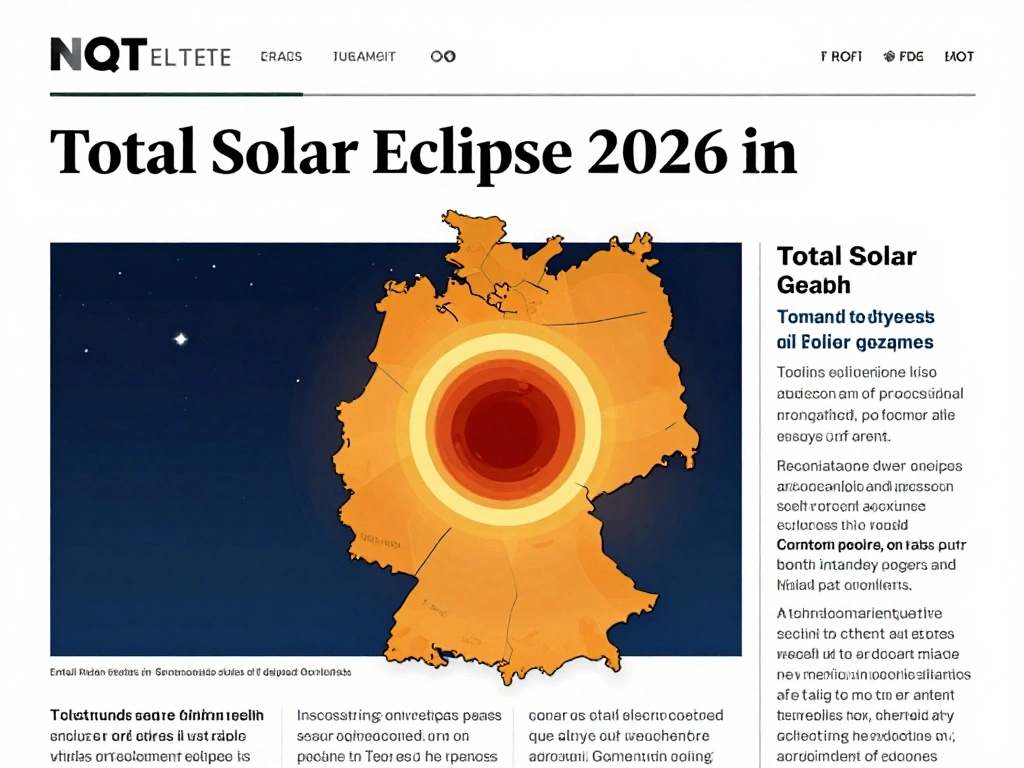
On the evening of 12 August 2026, skywatchers across Germany will witness a remarkable celestial event: a partial solar eclipse. While the total phase will not be visible from German soil, the Moon will cover a significant portion of the Sun, creating a dramatic spectacle as the sky dims. The eclipse will be particularly notable in the south, where the greatest obscuration occurs, though in some eastern regions like Vienna, the Sun sets before the maximum, so the eclipse will be cut short. This event marks the first total solar eclipse to cross mainland Europe in 27 years, with the path of totality sweeping across northern Spain, but Germany will still experience a memorable show.
For those in Germany, the partial eclipse will offer a unique opportunity to observe the Sun’s corona and the gradual darkening of the sky. The exact coverage varies by location, with northern Germany seeing a smaller bite out of the Sun, while southern regions will witness a more profound obscuration. It is crucial to use proper eye protection, such as eclipse glasses or solar filters, to safely enjoy the event. The next total solar eclipse visible from Germany won’t occur until 2081, making this a once-in-a-lifetime chance for many.
Meanwhile, NASA is gearing up for a high-altitude pursuit of the eclipse. A WB-57 research jet, equipped with the same cameras that flew during the April 8, 2024, eclipse, will chase the Moon’s shadow at 50,000 feet. This time, the cameras have been redesigned with critical exposure-time adjustments to fix the overexposure issues that plagued the 2024 imagery. The mission aims to capture unprecedented images of the Sun’s corona and study the solar wind, addressing one of the major unsolved problems in heliophysics. The data collected will complement the Parker Solar Probe’s ongoing investigations, providing new insights into the Sun’s outer atmosphere.
As the Moon’s umbra sweeps across Spain, millions of Europeans will look skyward. For Germany, the partial eclipse will be a reminder of the cosmos’ grandeur, and with NASA’s high-tech chase, the event promises to yield both awe and scientific discovery.

 Shimanta Das