Supreme Court Weighs Big Oil’s Bid to Kill Climate Liability Lawsuits
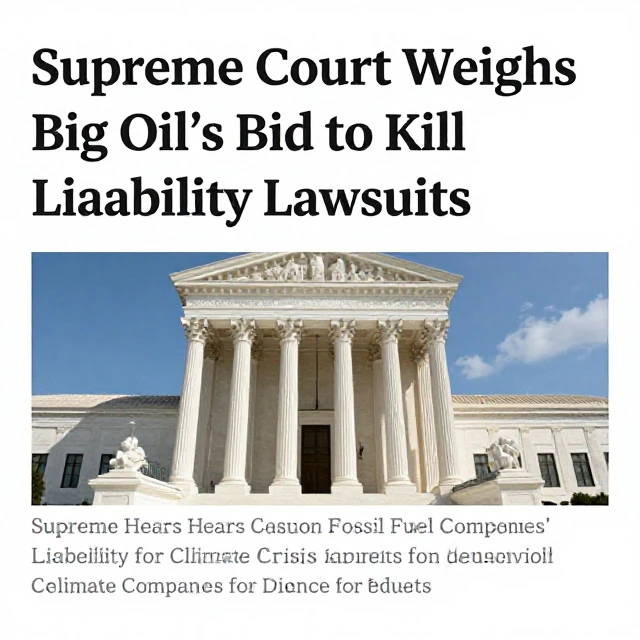
The US Supreme Court opened its new nine-month term on Monday by hearing arguments in a high-stakes case that could determine whether fossil fuel companies can be held accountable in state courts for their role in the climate crisis. The case stems from a lawsuit filed by Boulder, Colorado, seeking to hold oil and gas giants liable for climate-related damages. Although the case originated in Colorado courts, the companies asked the Supreme Court to intervene, arguing that climate change matters should not play out at the state level. After nearly two hours of arguments, it was unclear which way the justices were leaning, but experts noted that the court may find it difficult to craft a majority decision siding with industry.nnAt the heart of the dispute is whether federal law—specifically the Clean Air Act—pre-empts Boulder’s claims. The fossil fuel companies contend that the federal Clean Air Act pre-empts the case from state court, even though the law explicitly states that “air pollution control at its source is the primary responsibility of states and local governments.” They further assert that federal common law remains in effect and is embedded in the “structure of the Constitution,” despite the Clean Air Act’s clear designation of state primacy over local air pollution. Kannon Shanmugam, representing Suncor and ExxonMobil, argued that the case poses a significant threat because there are theoretically no limits on Boulder’s claims. If successful, he warned, the lawsuit could pave the way for tens of thousands of additional cases against the industry, as well as fuel retailers, automakers, and other emitters of greenhouse gases.nnDuring the hearing, Justice Brett Kavanaugh called the phrasing of Boulder’s attorney, Russell, “cavalier,” noting that the potential costs to oil and gas companies could be substantial. “There’s a lot of concern from the oil industry, from corporate actors, and from the conservative justices about the significant consequences of these cases,” observed Winter, a legal expert. The outcome remains in doubt, and the court’s decision could have far-reaching implications for climate litigation across the country. In its new term, the court will also hear major cases on immigration and guns, but this climate liability case stands out as a pivotal moment for both environmental accountability and corporate

 Shimanta Das