Cornell Protests Intensify Over Sexual Assault Investigation
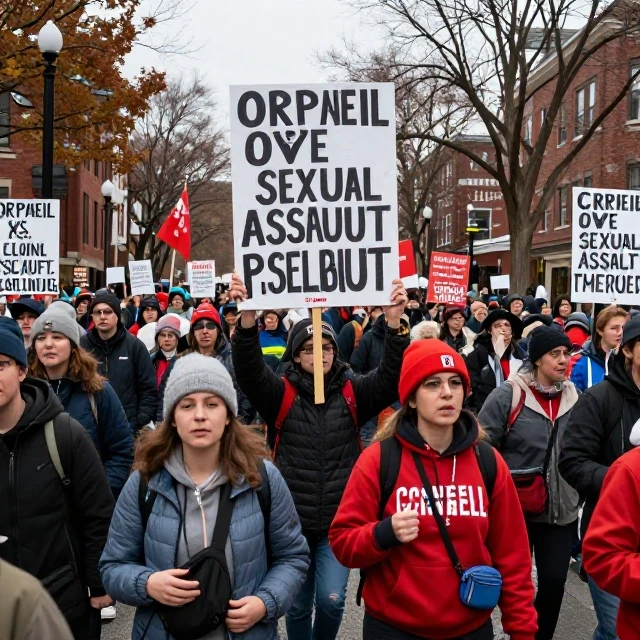
ITHACA, NY — More than 1,000 furious protesters marched on Cornell University’s campus Monday in support of the woman allegedly gang-raped in a fraternity — and demanded the resignation of the school’s president. The massive crowd of students, faculty, Ithaca locals, and outraged visitors gathered in the center of the Ivy League campus, with one sign reading, “We are all Jane Doe.” The demonstration underscores growing public scrutiny and pressure on authorities regarding the handling of sexual assault allegations.
Key takeaways from the protest highlight the community’s demand for accountability. The students’ petition called on the school to hire a different singer, arguing that Kehlani’s anti-Israel messages “go far beyond political critique” and go after the “vast majority of Jews” at the school who consider themselves Zionist. Additionally, after hours of passionate debate and public comment, the Ithaca Common Council passed a resolution Wednesday calling for a cease-fire in Gaza. The resolution calls for a bilateral cease-fire, the release of Israeli hostages by Hamas, access to humanitarian aid for Palestinians, and a recognition of the International Court of Justice’s ruling that Israel’s acts in Gaza constitute a plausible genocide. The resolution, initially introduced by First Ward Alderperson Kayla Matos, passed with nine “yes” votes and two “no” votes.
What to watch: The actions of key figures such as Letitia James, New York’s Attorney General, and Matthew Van Houten, the Tompkins County District Attorney, will be critical in the coming months. Their handling of the investigation and any potential charges will be closely monitored by the public and the Cornell community. The protest and the council’s resolution reflect a broader climate of activism and demands for justice on multiple fronts.
As the situation develops, the university faces mounting pressure to address concerns about campus safety and the treatment of sexual assault survivors. The remaining men were handed lighter punishments, a detail that has further fueled outrage. The coming weeks will test the resolve of both university administrators and local authorities to respond to the community’s calls for transparency and accountability.

 Shimanta Das